
How to Write a Killer Meta Description
When your audience is scrolling through search engine results pages, meta titles, and descriptions will help them decide whether or not to click through to your landing page. These short phrases and paragraphs populate search engine results pages to inform web users about the content on an associated web page.
Typically, a meta title includes a keyword from the web user’s search inquiry. The meta description supports the title and gives the user a little more information about why they should click on the link. Together, these phrases help you convince your audience that your content is worth viewing.
To help you secure that click onto your website and possibly a new patient at your practice, we’re going to go over how to write effective meta titles and descriptions for your web pages.
Stay tuned as we discuss how to identify these meta components, analyze meta description examples, and draft each for your website.

What Do Meta Titles and Descriptions Look Like?
If you’re having trouble picturing a meta title and description, do a quick Google search. Type in a search query, such as “most playful dog breeds.”
Take note of how the organic search results appear on the SERP or search engine results page. The meta title is the phrase in blue, followed by the URL for that particular web page in green. Below, the meta description provides a short snippet about what can be found on the page.
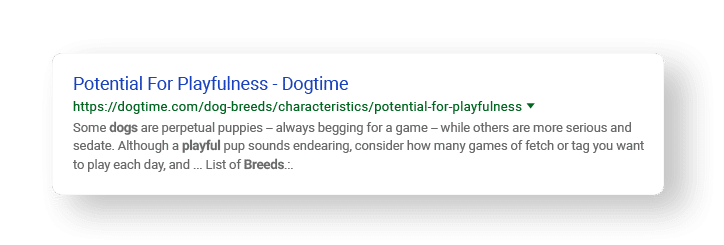
We don’t know about you, but we love some good alliteration. This title catches the eye! We were convinced to click through to this web page because of the lighthearted but clear meta title and the comprehensive meta description. On the page, we see what was promised: a list of the most rambunctious dog breeds!
A page’s meta description is a preview of the site and can impact its search traffic. That’s why you should make it a point to write a good meta description.
How to Write a Meta Title and Description
Now that you know how to identify a meta title and description, let’s look at examples of great ones and discuss what makes them work so well.
Be Mindful of Character Length
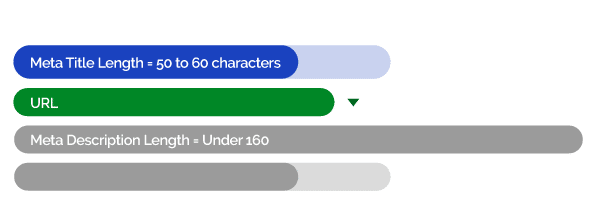
Search engines only give you so much space to describe your web page on SERPs, so you want to stick within that character length. On Google, this is about 50 to 60 characters for the meta title and under 160 for the meta description tag.
Now, you don’t have to meet these character limits. You just don’t want to exceed them. If you can write a compelling description in 100 characters, go for it! However, if you need a full 155 to get your point across, that’s okay, too.
The main goal here is to get the web user to click on your landing page. Hence, you should be mindful of the length of your meta description.
For the next example, let’s stick with dogs. Because who doesn’t like dogs?
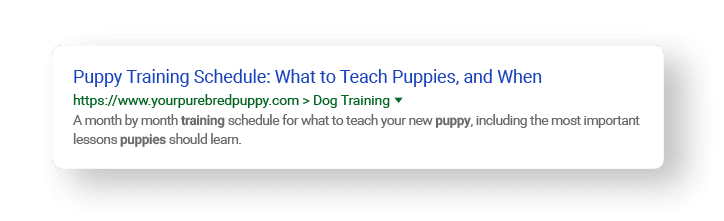
The meta title is 56 characters, which adheres to our first rule. This title features the keyword for the search query “puppy training schedule” (we will get to keywords in a minute) and tells us the main point of the web page.
The meta description is 128 characters, which falls a little short of our maximum limit. However, this description gives us just enough information to ensure that this page will satisfy our search query.
Be cognizant of how your meta tags appear on mobile screens, too. Sometimes, longer titles will appear stacked on search engine results pages.
Also, keep in mind that Google is not a stagnant entity. It changes all the time! This is why it’s important that you stay up to date on the latest news in SEO.
Every so often, Google decides to grant us longer character lengths, and other times, it takes characters away. Because of this, you may stumble across varying reports for the ideal meta title and description lengths. However, you will be safe by following our guidelines!
Use Optimized Keywords and Phrases

Keywords and phrases related to a search query are guaranteed to appear in meta tags. While Google’s algorithm considers over 200 ranking factors when determining which pages appear on SERPs, keywords are one of the most important (and well-known) ranking factors.
When you place keywords in your meta title, it signals to Google’s algorithm that your page is relevant to a related search query. While just placing keywords in your meta tags alone won’t snag you a top spot on Google, it is an essential aspect of your overall search engine optimization strategy.
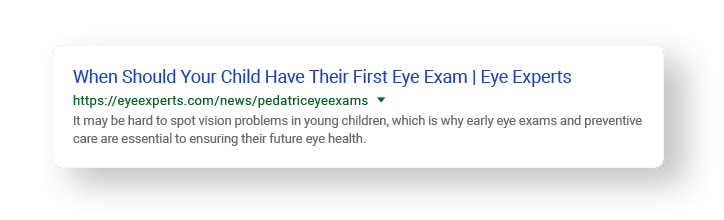
The search query might read something like “When should my child have their first eye exam?” or “Eye exams for children.” Note that, sometimes, the exact keyword phrase typed into the search bar isn’t what comes up on a SERP. Rather, it is oftentimes a variation of that keyword or a very closely related title tag. As mentioned, keywords in a meta title and description aren’t the only ranking factor to consider!
Beware of including useless or unrelated keywords to trigger a search query. You also don’t want to load your meta tags with keywords. This faux paux is called “keyword stuffing” and will negatively impact your SEO.
The Three C’s: Clear, Concise, Compelling

Now that we know that we need to input keywords into our meta tags and limit the character length on these SEO components, it’s time to get to writing!
When drafting your title tags and meta descriptions, follow our three C’s.

Your meta components should clearly describe what kind of content can be found on your landing page. The meta description lets you write a compelling statement about how your website will satisfy the user’s search query. However, you don’t want to use unnecessary language. Be concise and to the point.
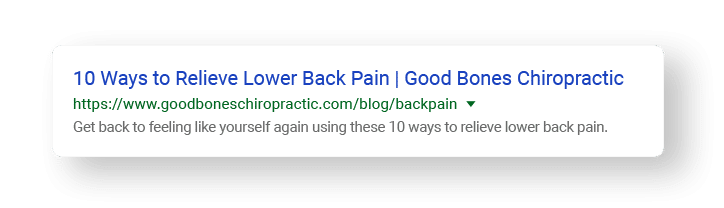
This is an excellent example of a compelling meta title and description. Clear? Check. Concise? Absolutely. Compelling? We think so!
This model follows one of our favorite formats for meta components on both organic results and paid ads. The title acknowledges a problem the web user is facing based on their search query.
The description tells the web user that the company’s content can help solve that problem. By addressing the user’s problem, you draw their attention. You may even gain a new client when you show them that you can help solve their problem.
Match the Description With Your Content
While your goal is to drive people to your website as you write a meta description, you shouldn’t generate meta descriptions just for the clicks. Search engines like Google might penalize you if you write meta descriptions for click-bait purposes.
What makes meta-descriptions important also is how they can affect bounce rates. A good meta description matches the actual content of the website. Moreover, it would help if you didn’t duplicate meta descriptions because it’s worked for others.
Search engine users are smart nowadays. They might exit your page right away if your compelling meta descriptions don’t fit what your pages contain. While you should craft meta descriptions for search engine optimization, everything should be aligned.
Include a Call-To-Action
Do you know what both search engines and users are looking for? A sense of direction. The perfect meta description would suggest what people need to do to take the next step.
If your search keyword is a particular service you’re offering, you should invite people to book an appointment. While you should use relevant keywords, it’s equally important to help people take the next step.
A great meta description would include inviting words like ‘Get it for free’ or ‘learn more.’ Choose the best one that matches the content you’re sharing. If you don’t use one that’s fitting, you might hurt your search results.
Useful Tips and Tricks

Do you want to write a good meta description? Here are some additional tips to take your meta description to the next level:
Check your meta description’s performance: Analytics tools like Google Analytics can help you see how your meta description is affecting your page’s overall impact.
Avoid repeating your title tag: While you can include key elements for SEO purposes, don’t copy everything verbatim. Include additional text or description to enhance your title tag and provide more information to your site visitors.
Provide solutions to a dilemma or problem: People usually search online, looking for ways to solve a particular issue. Your meta description should showcase how your web page can help users solve them accordingly.
Don’t overuse keywords: While a good meta description contains strategic keywords, you should avoid keyword stuffing. The sentences should flow and make sense for more people to visit your pages.
Title Tags and Meta Descriptions with iMatrix
Following our formula for successful meta components has the potential to help you boost your website’s search engine ranking and gain more web traffic. The better your visibility and the more clicks you get, the more people you can convert to clients at your practice.
Do you need more clarification on title tags and meta descriptions, or do you have another marketing question? Contact our team for a FREE consultation. We can help you write meta descriptions and more.