Optometry Marketing Ideas: 10 Proven Ways to Attract More Patients in 2026
You run a solid practice. Patients who visit you come back. The problem is getting them there in the first place.
Competition in eye care is fierce, with more than 43,000 optometrists practicing across the U.S., and most of them are targeting the same local patients you are. At the same time, demand for vision care is growing, with over 8.3 million Americans living with serious vision disabilities. The opportunity is real. So is the noise.
That’s why getting your optometry marketing right has become essential. Nearly three out of four patients now turn to online sources when choosing a healthcare provider. For local practices, that shift means your digital presence is no longer optional; it’s the first impression most new patients will ever have of you.
In this guide, you’ll discover what optometry marketing is, why it matters, and ten proven optometry marketing ideas that can help you attract more patients and grow your practice.
TL;DR: This guide covers ten proven optometry marketing ideas, from local SEO and paid advertising to referral programs and social media marketing, that help eye care practices attract more patients in 2026. The most effective approach combines a strong digital foundation (Google Business Profile, website, and online reviews) with targeted outreach to your local community. Practices that implement even a handful of these top strategies consistently see higher patient volume, stronger retention, and better return on their marketing investment.
What is Optometry Marketing?
Optometry marketing is the blend of digital tools and traditional marketing approaches that help eye doctors attract new patients while working to build relationships with existing ones. It spans channels like Google search, social media marketing, email campaigns, and SEO on one side; and community outreach, free vision screenings, and local partnerships on the other.
What makes it different from general healthcare marketing is the local nature of the business. Most patients are searching within a few miles of where they live or work. That means a well-optimized Google Business Profile, a website that converts visitors into bookings, and a strong presence in the local community can do more for a practice than any national campaign.
When these efforts work together, they don’t just drive new appointments; they build the kind of reputation that keeps patients coming back and referring others.
10 Top Strategies for Optometry Marketing to Grow Your Practice

1. Local SEO for Optometrists
Think about how most people search for eye care. When someone needs an exam or help with contact lenses, they don’t scroll through practices hundreds of miles away. They search for the closest option that feels reliable. Searches like “optometrist near me” or “eye exam near me” signal high purchase intent; the person isn’t browsing, they’re ready to book. That’s why local SEO is one of the most powerful tools for any optometry practice.
Nearly 46% of all Google searches are local, which means appearing in the local map pack can directly influence how many new patients walk through your doors.
Optimizing your Google Business Profile is the first step. Make sure your listing highlights accurate business hours, services like pediatric vision care and contact lens fittings, and professional photos that reflect your office environment.
In the current algorithm, GBP posts also carry weight — practices that regularly publish updates, offers, and seasonal content signal to Google that the profile is active, which supports local pack rankings. Responding to Q&A has the same effect, and it shows potential patients that your office is approachable and attentive.
Building consistent local citations across platforms such as Healthgrades, Yelp, Zocdoc, and your local chamber of commerce strengthens search engine visibility further. Even small inconsistencies in your practice’s name, address, or phone number can lower rankings, so accuracy across every directory is essential.
Finally, online reviews are trust signals that influence both rankings and patient decisions. Research consistently shows that the majority of patients across all age groups, not just younger demographics, trust online reviews as much as a personal recommendation before choosing a healthcare provider. Encouraging satisfied patients to leave positive reviews after a visit and responding professionally to bad reviews can make the difference between gaining and losing a new patient.
Checklist for local SEO success:
- Update and optimize your Google Business Profile regularly, including posts and Q&A
- Maintain consistent business listings across all directories
- Collect and respond to patient reviews, including negative reviews, to build trust
- Monitor performance and adjust when needed
- Optimize your website for mobile and fast load speeds
2. Your Website as a Patient Conversion Engine

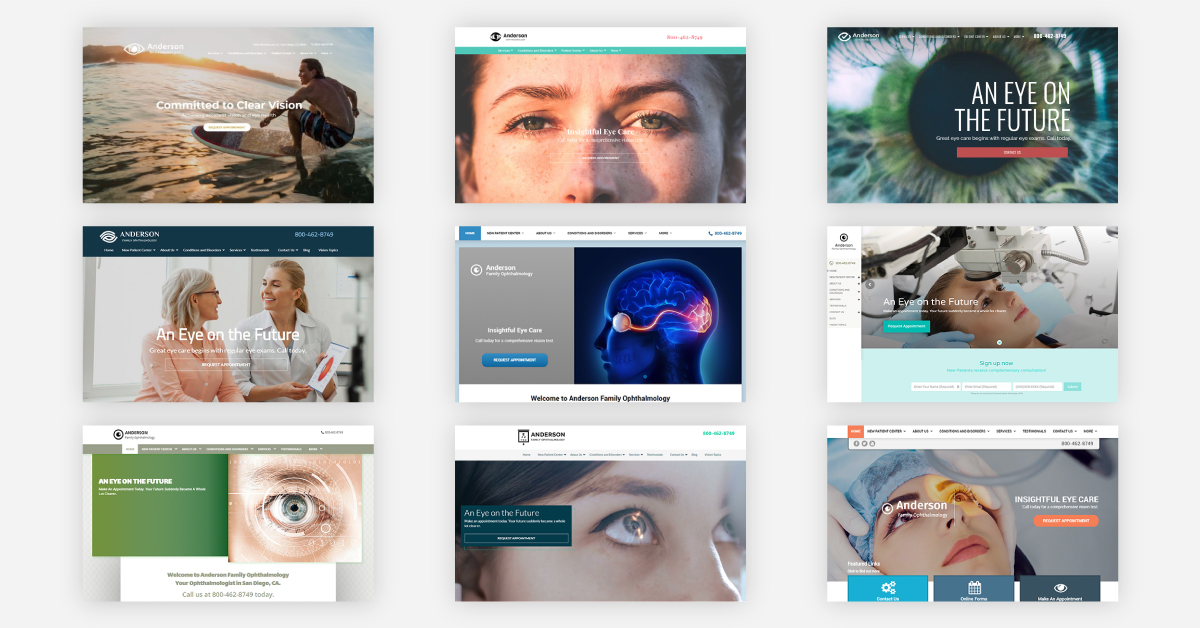
Most practices treat their website like a digital business card — name, address, phone number, done. But for the majority of new patients, your website is the deciding moment. They’ve found you through Google. Now they’re deciding whether to book with you or keep scrolling. What they see in the next fifteen seconds determines which way they go.
The first thing to get right is mobile. More than 60% of healthcare searches happen on a smartphone, often after office hours when your phones are off. That means a slow, hard-to-navigate mobile site isn’t just a design problem; it’s a patient acquisition problem. If someone can’t find your “Book an Appointment” button within a few seconds on their phone, they’re gone. Every page of your site should have a visible, easy-to-tap booking CTA, not just the contact page.
Online booking itself has become a baseline expectation. Patients searching for an eye exam at 9 pm aren’t going to call back in the morning; they’ll book with the practice that lets them schedule right now. Offering online booking, paired with automated appointment reminders, removes the friction that causes new patients to fall through the cracks before they’ve ever walked through your door.
Trust signals are what convert a visitor who’s on the fence. These include your optometrist credentials and certifications, accepted insurance logos, real patient photos (with consent), and genuine testimonials.
Practices that show the faces behind the care, like staff photos, a short “meet the doctor” section, consistently outperform those with generic stock imagery. If your website looks like it could belong to any clinic anywhere, it won’t give patients a reason to choose you specifically.
Finally, consider the full range of services your site communicates. Dedicated pages for specialties like myopia management, dry eye treatment, or pediatric eye care do two things: they help each page rank for its own set of searches, and they show families that your practice can care for the whole family, not just routine annual exams. A patient looking for a myopia solution for their child and a contact lens fitting for themselves shouldn’t have to wonder if you offer both.
Quick checklist for a patient-ready website:
- Mobile-first design with fast load speeds
- Visible “Book Now” CTA on every page
- Online booking available 24/7
- Trust signals: credentials, insurance logos, real patient photos
- Dedicated service pages for specialty offerings
- Digital intake forms to reduce friction at the first visit
3. Reputation Management and Review Strategy

Online reviews influence both how Google ranks your practice and whether a patient who finds you decides to book. Most practices focus on the second part. Fewer think about the first.
The biggest reason practices don’t have enough reviews is simple: no one asked. Satisfied patients rarely leave reviews unprompted. The fix is a systematic process. An automated text or email sent within 24 to 48 hours of a visit, with a direct link to your Google Business Profile. A brief mention at checkout reinforces it. The goal is to make it the easiest possible next step for your current patients.
When negative reviews do come in, your response matters more than the review itself. Future patients read both. Acknowledge the concern, stay calm, and invite the person to call and resolve it offline. Keep it short and professional. That response is really for your patient base reading it, not just the original reviewer.
Finally, review velocity matters as much as volume for local rankings. A steady stream of recent reviews signals a thriving, active practice to Google. Consistent monthly reviews outperform a large but aging stockpile every time.
4. Google Ads for Optometry

When a patient breaks their glasses or wakes up with sudden vision trouble, they turn to Google immediately. This is where paid advertising like Google Ads becomes invaluable, placing your practice at the top of search results even while your SEO is still gaining traction.
Keyword targeting is the foundation. Combining branded terms like “Dr. Smith Optometry” with non-branded searches like “affordable eye exam Dallas” captures both returning and new patients. Long-tail keywords tend to cost less per click while attracting high-intent searches.
Since 2024, Google’s smart bidding has taken over much of the manual work. Automated strategies like Target CPA and Maximize Conversions optimize spend in real time, while Performance Max campaigns distribute ads across Search, Maps, YouTube, and Display from a single setup.
Timing matters too. Back-to-school season in August and the FSA spend window in November through December are two of the highest-converting periods for optometry ads. Building both into your annual calendar ensures your budget works hardest when patient intent peaks.
Track every call, form submission, and booking from each website landing page so you always know what is driving results.
5. Meta Ads (Facebook and Instagram)

With more than 3 billion daily active users across Meta’s social platforms, Facebook and Instagram give optometry practices the ability to reach highly specific audiences with a precision that most other channels struggle to match.
Audience targeting is the core advantage. Parents can be reached with pediatric eye exam ads, young adults with contact lens promotions, and seniors with reminders about cataract monitoring. Retargeting adds another layer; if someone browses your website but does not book, follow-up ads can bring them back before they forget.
Ad format matters more than ever. In 2025 and 2026, Reels-based ads are consistently outperforming static images for healthcare advertisers. A short 15 to 30-second clip introducing your team, showcasing your office, or highlighting a specialty service drives higher engagement and lower cost per result than a standard image post.
As an advertising medium, Meta is accessible at almost any budget. Even $10 per day delivers measurable results when campaigns are built around clear goals and well-defined audiences. Just stay mindful of HIPAA guidelines. Targeting by demographics and interests is fine, but avoid ads that reference specific medical conditions directly.
6. Email Marketing and Patient Recall Campaigns
Email marketing generates $36 for every $1 spent, making it one of the highest-ROI channels available to any optometry practice. The key is building a structured sequence rather than sending one-off messages.
New patients should receive a welcome series that introduces your team, confirms what to expect, and sets the tone for a long-term relationship. Annual recall reminders keep your existing patients coming back without requiring them to remember on their own.
For lapsed patients who have not visited in over a year, a reactivation sequence with a direct reason to return, such as a vision check reminder or a seasonal eyewear promotion, brings a portion of your patient base back into your schedule.
Newsletters keep your current patients engaged between visits. Short educational content on vision care tips, frame trends, or upcoming clinic news helps your practice stay top of mind year-round without feeling like a sales pitch.
Referral programs, seasonal promotions, and FSA spend reminders in late fall also fit naturally into an email calendar, turning a single channel into a consistent driver of both new and returning appointments.
7. Patient Referral Program
Nearly 90% of patients check online reviews before booking, but a personal recommendation from someone they already trust carries even more weight. Word-of-mouth referrals convert at higher rates than almost any paid acquisition channel because the trust is established before the patient ever calls.
A well-structured referral program gives satisfied patients a reason to spread the word. Incentives generally fall into three categories: a discount on their next visit, loyalty points that build toward a reward, or a complimentary service such as a free eyewear adjustment or contact lens fitting. Complimentary services tend to feel more generous than discounts while also bringing the patient back into your practice.
Getting existing patients to participate starts with making sure they know the program exists. Mention it at checkout, include it in your email welcome and recall sequences, and add a short call to action in your newsletter. A simple “refer a friend and receive [offer]” line in a follow-up message is often enough to generate a steady stream of warm referrals from your most loyal patients.
8. SEO Content Marketing

When someone has burning questions about their vision or common vision problems, the first place they turn is usually Google. From “why are my eyes always dry” to “best contact lenses for screen use,” these searches create a steady flow of opportunities for practices that publish the right content.
Long-form blog posts structured with clear subheadings, FAQs, and internal links to your service pages serve both patients and search engines. Articles like “Signs you need an eye exam,” “Best contact lenses for dry eyes,” or “Blue light glasses: pros and cons” bring in organic traffic month after month.
In 2025 and 2026, structured FAQ content and direct-answer formatting do double duty. Google pulls these formats for Featured Snippets, and AI Overviews increasingly source their answers from the same well-structured, credible content. A practice whose blog answers patient questions clearly and concisely can appear in both traditional search results and AI-generated responses.
Always support claims with trusted sources like the American Optometric Association. If managing content consistently feels like a stretch alongside running a practice, an SEO partner like iMatrix can handle the strategy and execution.
9. Specialty Service Marketing (Myopia Management, Dry Eye, and Vision Therapy)
Routine eye exams are a commodity. Specialty services are where your practice stands out and where patient intent is highest.
A parent searching “myopia control for kids” or an adult searching “dry eye treatment that actually works” is not browsing. They have a specific problem and are actively looking for a solution. These searches convert at significantly higher rates than general “eye exam near me” queries because the patient already knows what they need and is ready to act.
Dedicated landing pages for each specialty raise awareness among patients who are actively searching while giving Google specific, rankable content to index. A myopia management page that explains the condition, outlines your treatment approach, and speaks directly to parents makes your practice the clear choice for families navigating that decision. The same logic applies to dry eye and vision therapy.
Each page targets its own set of high-intent keywords, builds credibility through patient education, and strengthens the overall authority of your website. Practices that actively market specialty services command higher revenue per patient and attract a far more motivated audience than general eye care advertising alone ever could.
10. Local Influencer Marketing and Community Campaigns

Free eye check-up events and local influencer partnerships look like different tactics, but they serve the same goal: building trust and visibility within your community before a patient ever searches for you online.
Community campaigns are a fantastic way to put your practice in front of families who might not find you through Google alone. Setting up at local schools, health fairs, or neighborhood events introduces your eye clinic to people who are far more likely to book after meeting you in person. Community involvement of this kind generates word-of-mouth that paid advertising cannot replicate, with roughly 25 to 30% of screening attendees going on to book a full exam.
Influencer partnerships extend that same local visibility across social channels. Parenting bloggers, lifestyle creators, and fitness influencers bring credibility to different audience segments, and partnering with a local sports team can amplify your reach across the community further still. Sponsored posts, office visit features, and eyewear giveaways help build brand recognition with audiences who trust an influencer’s recommendation far more than a traditional ad.
Building a Marketing Plan That Actually Moves the Needle
Not every practice needs to launch all ten strategies at once. The ones that see the fastest results start with the foundation and build from there.
Local SEO, a conversion-focused website, and a consistent approach to online reviews form the core. These three marketing activities work in tandem: your Google Business Profile drives local visibility, your website converts that traffic into booked appointments, and your reviews give patients the confidence to follow through. Get these right before spending a dollar on paid campaigns.
Once the foundation is in place, layer in paid advertising and content. Google Ads and Meta Ads accelerate patient acquisition while your SEO compounds over time. Specialty service pages, email sequences, and referral programs then work to increase revenue per patient and make your practice stand out in a competitive local market.
Nearly 90% of patients check online reviews before booking. With the right marketing ideas behind you, your practice becomes the obvious choice.
If you are ready to build a plan that delivers measurable results, call 888.792.8384 to get special pricing with iMatrix today.
FAQs
What is the most effective way to get new patients for an optometry practice?
The most effective starting point is a strong local search presence. Since 77% of patients begin researching care through a search engine and 86% of consumers use Google Maps to find local services, an optimized and active Google Business Profile is essential. Pairing that with online booking, which over 60% of patients prioritize when choosing a provider, creates the strongest foundation for consistent new patient acquisition.
Does local SEO really work for small eye care practices?
Yes, and the data supports it. Since 86% of consumers use Google Maps to find local products and services, and 77% of patients start their care journey through a search engine, practices that rank in the local map pack have a direct advantage in attracting new appointments. Integrating local keywords into website content, title tags, and meta descriptions further strengthens visibility for the specific searches your patients are already making.
How do I market my optometry practice on social media?
Start with video content. The average internet user spends 28% of their online time on social media platforms, and video is the format most likely to build trust because it comes closest to a real one-to-one interaction. Short clips introducing your team, explaining common eye conditions, or walking through your office perform well across Facebook, Instagram, and Reels, and consistently outperform static image posts for healthcare advertisers.
Does seasonal marketing work for optometry practices?
Seasonal campaigns are one of the most reliable ways to drive appointment spikes. One practice reported a 30% increase in bookings within eight weeks of launching a targeted back-to-school campaign. Beyond the school season, campaigns aligned with dry winter eye conditions, spring allergy season, and FSA spend deadlines in November and December all prompt patients to schedule appointments they might otherwise delay.
What is a good patient referral program for an optometry office?
Referral programs are among the most effective marketing strategies for optometry practices because patients consistently rely on recommendations from friends and family more than any advertisement. A simple incentive structure works best: a discount on the next visit, a complimentary service, or loyalty points for each successful referral gives satisfied patients a concrete reason to spread the word. The key is making the program visible at checkout and reinforcing it through your email sequences.